Showing posts with label dystopia. Show all posts

Thursday, December 31, 2015

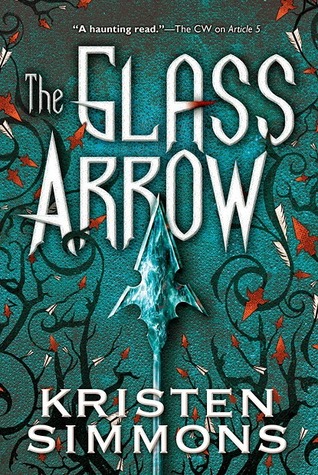
The Glass Arrow - by Kristen Simmons

My rating:

The Handmaid’s Tale meets Blood Red Road in Glass Arrow, the story of Aya, who lives with a small group of women on the run from the men who hunt them, men who want to auction off breeding rights to the highest bidder.
In a world where females are scarce and are hunted, then bought and sold at market for their breeding rights, 15-year old Aya has learned how to hide. With a ragtag bunch of other women and girls, she has successfully avoided capture and eked out a nomadic but free existence in the mountains. But when Aya’s luck runs out and she’s caught by a group of businessmen on a hunting expedition, fighting to survive takes on a whole new meaning. (Goodreads)


I found The Glass Arrow when I was looking for standalone YA novels. I have nothing against series, but I've read so many lately and I'm getting really impatient waiting for sequels. A world where women are sold as property seemed like an interesting premise, and I think Simmons pulls it off fairly well. We don't get a lot of background on how this situation came about, but that didn't bother me too much. The worldbuilding is solid enough to paint a good picture of the current state of things, and this is accepted as the status quo. I think the lack of background is also less important than in many YA post-apocalyptic novels because of one key difference - there's no hero trying to change the world. Without any kind of revolution, it's easy to accept the situation that the protagonist, Aya, has been put as something that just happens in this world. This isn't to say that Aya isn't a great, strong character; she definitely is. In this novel, though, Aya isn't using her situation to spark a rebellion, she just wants to escape so her life can go back to normal.

Another, very welcome, change from most YA books these days - no ridiculous love story / triangle!!! Yes, there is some romance, but it's introduced slowly and naturally. I'll admit the end result was somewhat predictable, but considering Aya's love interest, Kiran, is pretty much the only guy she interacts with who isn't physically beating her into submission or trying to buy her as property, there's not room for much suspense about who Aya will end up with.

As far as the characters themselves, I thought they were pretty solid. Aya and Kiran are the only one's we really get to know well, but they're good protagonists. Aya is strong, smart, brave, and extremely stubborn. Even though she does come off as superior to many of the other girls waiting to be bought, we at least have the excuse that she's from the outlying mountains. Aya is strong and smart because that's the only way to survive, not because she's just special. Most of the other girls have grown up in the city, expecting to be sold someday and they're more or less resigned to their fate. Kiran is also from the mountains so his survival instincts pair well with Aya's personality. I also think Simmons did a great job of writing Kiran, who can't talk. He starts visiting Aya after she's been captured, and even with no dialogue on his side, we get a good idea of who he is.

After all the great things I've said about this book, I feel like I have to justify why I gave it three stars. First of all, I would have liked some more information about the secondary characters. We don't really get to know any of them or get any back story so they ended up feeling like placeholders to facilitate or hinder Aya and Kiran's plans. On top of that, something about the writing style and pacing of the story didn't grab me like some books do. It wasn't so bad that I lost interest, but I wasn't desperate to keep reading either.  The Glass Arrow is certainly still a good novel, and I would certainly recommend it  for anyone who likes the post-Apocalyptic YA genre.

Wednesday, November 25, 2015

The Water Knife - by Paolo Bacigalupi

My Rating:                  


Despite working in a library in the same state as the author, Paolo Bacigalupi, I had never heard about The Water Knife. Then a couple of friends suggested we read it for a book discussion. From their very brief description I went to pick it up from the library thinking it was some sort of realistic fiction novel about current water rights, which didn't sound especially exciting to me at the time. Instead, I ended up with one of the best sci-fi novels I've read in a long time.

While The Water Knife isn't contemporary, realistic fiction, references to the cultural and political situation make it clear that this takes place in the near future. The southwestern United States have essentially become a war zone because of water shortages. Catherine Case, queen of the Colorado, ruthlessly buys and cuts water rights from her offices in Las Vegas. These rights often put her totally in control of whether a city lives or dies, and she think Phoenix is about to die.

Bacigalupi brings the focus to Phoenix with narration by three separate characters. First we have Angel, originally from Mexico and later an immigrant to the US, he is pulled from prison by case to work as what the public refers to as a water knife. Basically, when Case decides it's time for a town to die so she can divert their water, water knives do the dirty work. Now she's sent Angel to Phoenix to see what the situation is.

Then we have Lucy, a journalist who always has an eye out for a story. Unlike most, Lucy moved to Phoenix by choice and is now writing what is known as "collapse porn"- stories covering the slow, but seemingly inevitable, collapse of the city. Her sister is constantly urging her to leave, but even as the bodies start piling up around her, Lucy is determined to stay put.

Finally we have Maria, a refugee from Texas. As the water dried up, the Texans were forced to pack up their lives and leave. Now that states are closing their borders, though, it looks like Maria's gotten herself stuck in Phoenix with nowhere to go.

The novel starts with each of these characters in seemingly unrelated plot lines, that slowly converge until, by the end, all three have come together. I feel like I've read a fair number of books where this process leaves all the characters in story lines that are too far fetched even for fiction, but Bacigalupi does a great job. The characters are wonderfully developed, and they never are never forced into doing something that doesn't seem natural just to bring the plots together. When all three characters finally end up in the same place, it feels not so much predictable, as inevitable.

I also love that the science part of this science fiction novel completely holds up. This might be because it's set in the very near future, but I know Bacigalupi has written other science fiction that isn't so close to our own time.While I haven't read his other works (yet), they seem very popular and I'm inclined to think that the believability of the science in this book also has a lot to do with Bacigalupi's skill as a writer. When I read science fiction, no matter how removed from the current reality, I want the author to convince me that the technology is sound and definitely possible. Otherwise I would read fantasy, which I love, but I don't expect the technical explanations that I do from sci-fi.

I also got a sense that Bacigalupi might be hinting towards a more drastic climate change situation worldwide, and not just the droughts in the Southwest, but not many people I've talked to about this book thought so. If it was on purpose, it was explicit, but there were plenty of mentions of huge increases in the number of hurricanes near New Orleans, weather problems in India, and the unceasing rain in the background every time Lucy would Skype with her sister. Regardless of whether or not there's some sort of statement about climate change, I would highly recommend this book to just about anyone. It's great sci-fi writing, but also current enough that I think even readers who aren't fans of the genre would really enjoy this novel. The Water Knife is a violent novel at times, but I felt it was done in a way that the depictions of violence contributed to setting the scene in a dystopian Phoenix. That said, if you can't handle some detailed descriptions of violence, I would stay away from this book.