
My Rating:
“Whom to marry, and when will it happen—these two questions define every woman’s existence.”
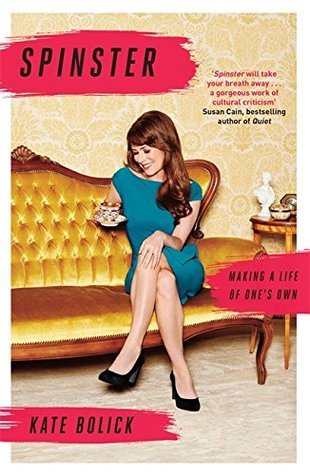
So begins Spinster, a revelatory and slyly erudite look at the pleasures and possibilities of remaining single. Using her own experiences as a starting point, journalist and cultural critic Kate Bolick invites us into her carefully considered, passionately lived life, weaving together the past and present to examine why she—along with over 100 million American women, whose ranks keep growing—remains unmarried. (Goodreads)
I found Spinster: Making a Life of One's Own, without really looking for it. I wanted a new audio book to listen to and I was having a hard time finding anything from Overdrive that didn't have a long hold list. Goodreads had voting open for the Goodreads Choice Awards at the time so I decided to scroll through the lists of nominees. I was intrigued by Spinster and when I found the audiobook download with no hold list, I was sold.
Overall I really enjoyed this book, but I feel like the first half was much stronger than the second. What I liked best about Bolick's writing in this book is how well she mixes memoir with an academic introduction to her five "awakeners" - Neith Boyce, Maeve Brennan, Charlotte Perkins Gilman, Edna St. Vincent Millay, and Edith Wharton. The narrative effortlessly switches between accounts of these women's lives and writing and more personal accounts of Bolick's own experiences. I hadn't even heard of most of these women and knew nothing about any of their writings, so I really enjoyed the well-researched information provided in Spinster. I did feel, though, that this information got repetitive as the book went on. I liked the first half of so of the book so much because Bolick was still in the process of introducing these women and I was constantly learning something new and interesting, but once they had been introduced I feel like a lot of the same arguments, quotes, life stories, etc. were reused later in the book. This was harder to verify with an audio book, but I know there were times where I could have sworn a phrase or quote was repeated word for word, with no new analysis to warrant the repetition.
As far as Bolick's exploration of spinsterhood, I had mixed feelings. On the one hand, Bolick is not exactly a spinster and she freely admits that she can hardly walk down the street without arranging a date. Her spinster role models are, for the most part, not spinsters either. On the other hand, I liked Bolick's attempt to redefine the entire meaning of "spinster" and this made me somewhat more convinced about the inclusion of both the author and the women she writes about into the world of spinsterhood. Spinster does not necessarily have to mean a woman alone, instead, Bolick proposes spinster as a term for a woman who does not feel dependent upon or forced into relationships with men. In this sense, Bolick definitely seems to qualify as a spinster because I, at least, got the sense that while she enjoys relationships with men, she's not just waiting for someone to come along and marry her.
I think the title could be somewhat misleading if women are looking for a book about actually being single, but overall I think Bolick's premise still makes for an enjoyable read. What I took away from the book, though, was Bolick's courage to make her own life just how she wanted it to be. She wanted to be a writer, so she picked up her things, found an apartment, and became a writer. If she ended up in a job that wasn't right for her, she left. When she felt like she needed to spend some time back her hometown, she picked up her things again and moved back. I always spend too much time overthinking my life decisions and trying to determine what people will think of me if I make a certain decision. It was really refreshing and inspiring to read about someone who seems to be confident in her decisions and is leading a successful life.
If you're looking for a book about actually living as a spinster in the way most people would define the word, this book might not be for you. It's also not especially groundbreaking in terms bringing something new to feminism, which I wasn't expecting, but some people might be. I will admit I was a bit disappointed that in all her discussion of relationships and marriage, Bolick completely left out any commentary on what the societal pressures are for people who identify as LGBTQ. I still enjoyed this book, though, and if you do read Spinster I would definitely suggest taking a look at the "Spinster Kit" that you can download from Bolick's website here. This kit has some of the normal components you would expect from a book kit such as book club resources and reading lists, but also has the added fun of cocktail recipes and paper dolls.
I think the title could be somewhat misleading if women are looking for a book about actually being single, but overall I think Bolick's premise still makes for an enjoyable read. What I took away from the book, though, was Bolick's courage to make her own life just how she wanted it to be. She wanted to be a writer, so she picked up her things, found an apartment, and became a writer. If she ended up in a job that wasn't right for her, she left. When she felt like she needed to spend some time back her hometown, she picked up her things again and moved back. I always spend too much time overthinking my life decisions and trying to determine what people will think of me if I make a certain decision. It was really refreshing and inspiring to read about someone who seems to be confident in her decisions and is leading a successful life.
If you're looking for a book about actually living as a spinster in the way most people would define the word, this book might not be for you. It's also not especially groundbreaking in terms bringing something new to feminism, which I wasn't expecting, but some people might be. I will admit I was a bit disappointed that in all her discussion of relationships and marriage, Bolick completely left out any commentary on what the societal pressures are for people who identify as LGBTQ. I still enjoyed this book, though, and if you do read Spinster I would definitely suggest taking a look at the "Spinster Kit" that you can download from Bolick's website here. This kit has some of the normal components you would expect from a book kit such as book club resources and reading lists, but also has the added fun of cocktail recipes and paper dolls.


